

 DE
What helps with eczema and other skin inflammations?
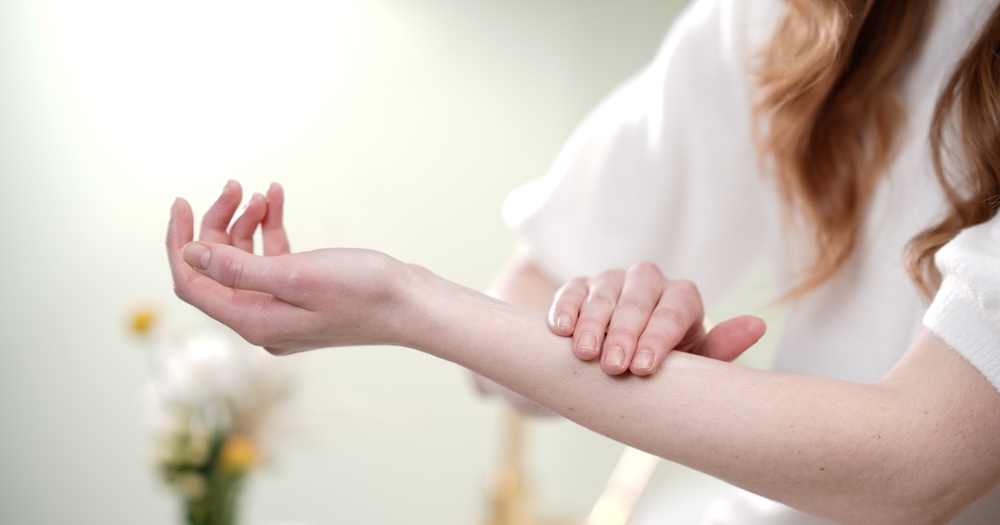
Our skin is exposed to various stimuli every day. The skin’s natural defense reaction usually regulates this, often even unnoticed by us. However, if the skin is directly damaged or an allergic reaction is triggered, redness, itching, flaky skin, or even blistering can be a visible consequence.
In such cases, a doctor should always be consulted to determine the specific cause and the correct therapy to alleviate symptoms. Particularly noticeable skin changes on the face or hands should be treated as quickly as possible. To answer the question of what helps with eczema and other skin inflammations, we have summarized the most important facts.
What promotes skin inflammations such as eczema?
Nowadays, the production of, for example, clothing, jewelry, or care products is not always transparent and therefore difficult to trace. If the skin reacts to one of these products, the search for the actual cause often begins. Some clothing contains a variety of chemical substances, such as pesticides for a good cotton harvest yield, dyes for the right, fashionable color, or finishing materials for a wrinkle-free look. All of these can be causes of an itchy skin reaction. Fashion jewelry often contains components of nickel or chromium-nickel compounds. And in times of a pandemic, repeated disinfection and hand washing also have consequences.
The initial contact is usually not directly triggering, but often sensitizing. If renewed contact occurs, the sensitized body releases messenger substances that result in corresponding inflammatory reactions. However, this does not apply to everyone. Predispositions or special conditions can be triggers or causes for this so-called contact dermatitis or contact eczema.
What helps with eczema?
In most cases, it is external influences that irritate the uppermost layer of skin and can lead to eczema. The positive aspect is that this type of skin inflammation is not contagious. Understandably, the resulting symptoms of eczema are negative. In difficult cases, an individually adapted and accompanying treatment by a doctor is recommended. In milder cases, moisturizing products can help, for example, with eczema on the hands. The general recommendation is: moist on moist and fatty on dry. This principle means that weeping eczema with blistering should optimally be treated with moist and cooling compresses. A rather dry and flaky eczema, on the other hand, should be treated with a lipid- or urea-containing product.
Home remedies for treating eczema are also often discussed to alleviate accompanying symptoms, for example:
- Honey, which soothes and disinfects. The itching associated with eczema is probably the most unpleasant symptom, and an antibacterial and soothing effect is helpful. However, the application with the sticky mass is probably not entirely optimal and requires time and patience.
- Cucumbers contain a lot of moisture and can cool the affected skin. Their anti-inflammatory effect also alleviates symptoms for the moment.
- Tyrosol, a component of olive oil, is said to have an anti-inflammatory effect. Thus, olive oil is also considered a tip among possible home remedies for eczema.
However, the principle mentioned above must also be observed here. Furthermore, these home remedy recommendations do not apply if internal influences are the cause of eczema. In such cases, a predisposition is usually assumed. Often, atopic dermatitis or atopic eczema is present, also known as neurodermatitis. Here, home remedies do not help; only expert knowledge does.
Many eczemas caused by external influences, however, can also heal on their own. It is always important to identify the trigger and avoid or even remove it through preventive measures. This is the only way to quickly break the vicious circle of irritation, itching, and scratching. Itching, in particular, is distressing for many. But scratching, in particular, introduces bacteria and germs into the affected areas via fingers and fingernails, causing further itching and thus an optimal basis for further inflammations or eczema.
Does this also apply to other skin inflammations?
Often, too much care simply overwhelms the skin. A large number of products, with various compositions or for the wrong skin type, can cause long-term damage. This also applies to excessive bathing or showering. The natural acid mantle is attacked. Eczema or perioral dermatitis can be the result. Therefore, application should be reduced to a minimum to restore balance.
However, in many cases, this is not so easy. Often, affected individuals repeatedly come into contact with triggers in their profession. This can even lead to a job change if only complete contact avoidance helps. Anyone can be affected, regardless of age or gender, but the symptoms can vary. However, those prone to eczema can take preventive action:
- Good and adequate skin care prevents the skin from drying out and protects against external influences. Always intensively care for sensitive skin with healing eczema so that the skin barrier can be restored and moisture can be supplied more effectively.
- Reduce contact with cleaning agents, other chemical substances, or fragrances as much as possible.
- Shower and bathe only in moderation to protect the skin barrier.
- Always wear protective clothing when performing skin-stressing work.
- Avoid scratchy or friction-intensive clothing,
- as well as allergy-triggering substances or foods.
What helps with eczema and other skin inflammations? More interesting information on possible skin problems, treatment options, and possible home remedies can be found here in our Skin Journal.
 AdobeStock - ilon hautpflege

